Free shipping on every order · 90-day guarantee · Molded in Orange, California
The Puzzle Cup Holder.com

Finally, somewhere to put your drink off the puzzle table.

4.9 from 119 Steadi reviews

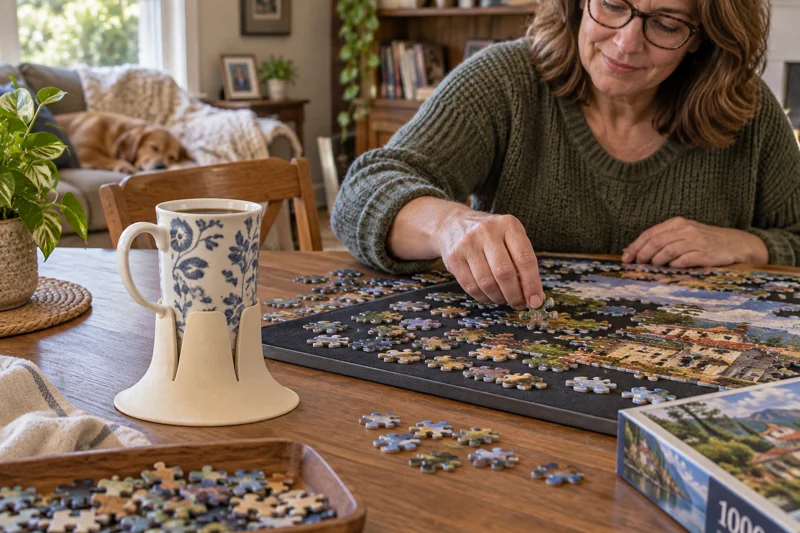
A flexible-finned base holds your tea, wine, or seltzer steady on the puzzle table itself — clear of the pieces, out of the way of the elbow that swings wide for the far corner.

Give my drink a spot at the table — from $14.95

Free shipping, 30 evenings to prove it earns a spot next to the sorting trays — or it goes back, no fight.

Will your puzzle-night cup fit? A sticky note answers it — the test is below ↓

Prefer the maker's own store? steadilabs.com →

Left to right: the wide, low base empty, then holding a cup, a can, and a large tumbler.
One base, clear of the trays. Empty, then a cup, a can, and a 40 oz tumbler — same base, same grip, clear of the pieces.

The moments

Moments every dissectologist knows by heart.

Mid-reach, any evening

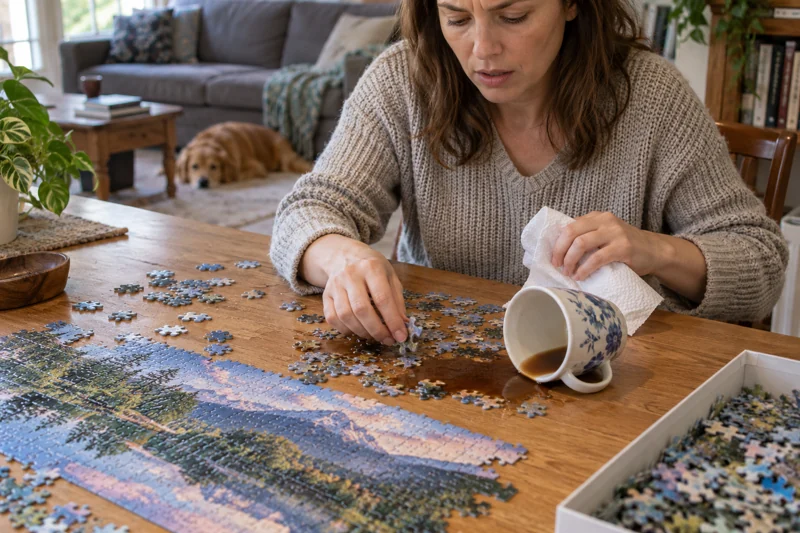
Testing what turns out to be a false fit, then trying again with your arm extended flat over the puzzle's far corner — the trailing elbow finds the glass parked at the rim on the way back. One salvage-guide author reports this exact catch twice, months apart, each time under paper towels by morning.

Day one, box just opened

Pieces dumped, borders pulled and sorted border-first, the box lid drafted into service as a spare tray. Every flat inch is spoken for before a single interior piece is placed, and the seltzer can ends up on the windowsill or the seat of the empty chair.

The tilt goes up

The board gets propped to spare your neck, and the tea loses its last legal parking spot in the same motion — nothing left but the floor beside the chair, or a cup holder hanging off the frame.

9 PM, deep in the sky section

Lamp on, second refill poured, nothing left to place but single-color pieces. The glass has migrated onto the last free inch at the puzzle's own edge, closer to the work than it's ever been, right as the session runs longest.

The morning after

Water hit a corner overnight. You peel the wet pieces free, sandwich them in paper towels under a stack of books, and wait to find out whether they dry flat or split into layers.

The paper test

The fit test that fits next to the sorting trays.

your cup's base
lands in here

A square sticky note: 3 inches, exactly — the ceiling for what fits next to the puzzle.

01
Pull a sticky note off the pad.

The standard square measures exactly 3 inches on a side — a fact about sticky notes, not your cup, and it happens to mark the ceiling of what fits.

02
Set your cup on it, base down.

Skip the rim and look at the bottom — that's the only measurement a crowded table cares about, whether it's the tea gone lukewarm or the tumbler you carried over from the kitchen.

03
Read the fit.

Base lands inside the square? It settles in. Base hangs over an edge? Too wide. Base barely covers a thumbprint at the center, under 2 inches? Too narrow for the fins to close around.

The sticky note settles the question before the cup ever lands on the table — no calipers, no spec sheet, no guessing between rounds of sorting.

What fits

The bottom inch decides what survives the table.

One range decides every verdict here: a base 2 to 3 inches across settles in and stays. That's the whole rule the fit list below runs on.

  • Stanley 40 oz H2.0 FlowState Quencher fits
  • Insulated travel cup, no handle fits
  • Standard 12 oz can fits
  • Slim seltzer can fits
  • Energy drink can fits
  • Pint glass of water fits
  • Wine glass, stemmed fits
  • Kids' straw cup fits
  • Coffee or tea mug, handled handle blocks the fins
  • Espresso cup too narrow

There's a floor as well as a ceiling — under 2 inches the base sits too loose to grip. And the handled mug is the honest exception on this list: the base itself fits the range, but the handle lands right where a fin needs to close around it.

The full fit database — Stanley, Red Bull, Yeti, and 30 more, with sourced base measurements →

What's in it

Three reasons it holds its ground on a crowded table.

01

Holds its footing on a bare table.

This isn't a soft-surface trick — the wide, low base and the fin grip work at least as well on a hard, flat tabletop as they do anywhere else. Set it beside the puzzle, the felt board, or the folding card table, and a bumped elbow moves the base, not the drink.

02

Grips what you actually bring to the table.

The tea, the seltzer can, the stemmed wine glass, the 40 oz tumbler — cans and bottles slide on, glasses and tumblers drop in through the fins and get held by the bottom inch, so a graze sends the base sliding instead of the drink tipping.

03

Takes up less room than the coaster it replaces.

One flat piece of matte flexible material — no clamp, no jaw, no gadget shine. It fits in whatever sliver of table isn't already claimed by trays and pieces, and stows flat in a drawer or the puzzle box when the table goes back to being a table.

Why more than one

Two identical travel cups. Whose tea is whose?

A family puzzle night rarely means one drink at the table — the same plain travel cup shows up twice, parked within reach of the same sorting tray. By the second hour of the session nobody remembers whose tea has gone cold and whose is the fresh pour, and the group chat's already teasing whoever grabs the wrong one.

Build your set

Give everyone their own.

Pick a pack, then give each one a color — so nobody has to ask which drink is theirs.

Plain mechanics

Built for the elbow, not just the table.

The base grips the table.

A hard tabletop doesn't swallow a narrow base the way a soft surface can — but a bump can still send a narrow glass sliding clean across it. The wide, low base sits low and spreads its contact across the table, so a nudge from a reaching elbow moves the base, not the drink.

The fins hold the cup.

Flexible fins grip the drink by its bottom inch, so a knock doesn't have far to travel — the low, wide base rides it out instead of the glass going over.

It settles back.

An elbow grazes it, someone leans across for the far corner, a piece gets pressed a little too hard nearby — its low, wide weight rocks and returns the drink to level instead of carrying that motion into a tip.

It doesn't need the table's last inch. No clamp on the edge, no jaw that needs an apron-free lip, no bolt-on holder hanging off a tilted frame. It sits on top of the table, the board, or the chair arm exactly as it is, and it moves from the dining table to the card table in a second.

Already claimed

Hard, flat, and still no room for a drink.

None of these is unstable in the way a soft, sinking surface is — the surfaces themselves are mostly hard and flat. The problem is occupation and motion: every inch is claimed by the puzzle, and what's left gets shaken each time someone leans in to press a piece.

Dining table, mid-puzzle

The table itself is hard, flat, and plenty stable — this isn't a wobble problem. The puzzle finishes at 27 by 20 inches, and the sorting trays and box lid claim what's left, so there's no free real estate for a drink until the puzzle comes down, sometimes weeks later.

The felt puzzle board

Felt does one thing beautifully — keeps pieces from sliding on the trip to the table — and one thing badly, which is contact with liquid. The board gets lifted, slid, and rotated mid-session too, jostling anything parked at its edge.

The tilting easel

Propping the surface to roughly 20 or 30 degrees spares the neck, and it also makes the work surface unusable for anything that isn't clamped down — physics that even easel makers concede by hanging a cup holder off the frame instead.

The folding card table

A thin top and folding legs flex under a leaning elbow, and that bounce travels straight into whatever's standing on it. The rolled edge sits low too, so a full glass near the rim is one knee-bump from the floor.

The coffee table beside the couch

Low, crowded with the box lid and the reference poster, and below the puzzler's sightline while their attention is locked on the board — the drink shares elbow room with the sorting clutter at shin height.

Why drinks tip over at the puzzle table — and what actually holds one steady — the full story →

Versus what you do now

The workarounds every puzzle table has already seen.

A clamp-on desk cup holderThe Puzzle Cup Holder
Needs a table edge to gripJaw opens about 1.5 to 1.6 inches — thicker table aprons and board lips defeat itNo edge needed — sits flat on the table itself
Fits a 40 oz tumblerBasket tops out around 3 to 4 inches — a tight fit for a big tumblerFins flex around the base and it settles in
Where the drink ends upHangs below the table lip, down near the kneeRight on the table, at hand
Moving to the card tableFixed to one edge — unclamp, find a new spot, clamp againPicks up and sets down anywhere flat
Table space claimedNone on top — it mounts below the edge insteadA few inches of tabletop, about what a coaster takes
Holds up over a seasonBuying guides warn to pick a strong, non-slip clampOne molded piece, nothing to loosen or reclamp
CostAnother purchase, hoping the edge it needs actually fitsOne small piece that works on any flat surface
The clamp-on desk cup holder

Buying guides for the category admit the limit in their own spec sheets: the clamp jaw typically opens only about 1.5 to 1.6 inches, so a dining table's apron or a thick puzzle-board edge defeats it outright. The cup basket tops out around 3 to 4 inches across, too tight for a big tumbler, and the whole rig ends up hanging below the table lip at knee height.

The puzzle table's built-in cup holder

At least one tilting puzzle table ships with a cup holder that hangs off the frame — an accessory that exists only because the tilted work surface can't hold a drink on its own. It rides the same frame that reviews already fault for wobble, broken latches, and weak center panels, so every lean-in to press a piece shakes the holder too.

The coaster

A coaster answers the ring, not the knock-over. The documented puzzle spills happen mid-reach, when a sleeve or elbow catches the glass — a coaster does nothing to keep a bumped drink upright, and on a crowded table it's usually the first thing buried under a sorting tray anyway.

The no-drinks-at-the-table rule

The abstinence approach, and the number of step-by-step guides for drying out a soaked puzzle says how well it actually holds. Puzzle nights run for hours with tea or wine as part of the ritual — the drink comes to the table regardless, just without anywhere safe to stand.

From the reviews

What buyers say.

Recent reviews of the Steadi, from every room and rig it lives in.

★★★★★

I have a tendency to spill my drinks and have two cats. This is one of the best things I’ve ever impulse bought. It works. It actually works. It’s a heavy, wide enough base that it is actually stable. My “spot” in the living room is near a somewhat-cushioned fabric ottoman, which is where I usually put my drinks. It’s

Dixie · 2026-08-30
★★★★★

I love mine. I just wish the price was more appropriate. $15 seems a lot for a small plastic item. Reduce it to $9.99 and free shipping and I'll buy a few more!

Carolyn G. · 2026-08-27
★★★★★

Excellent!

Brian S. · 2026-08-27
★★★★★

Thank you for your service!

Brian S. · 2026-08-27
★★★★★

It’s great love it

gilbert a. · 2026-08-24
★★★★★

I never knock over my water at night anymore!

Customer · 2026-08-21

Read all 119 reviews →

All 119 reviews are for the drink base itself, collected across every place people use it.

Fair questions

You're probably thinking…

“I've bought puzzle gadgets like this before and they just end up in the drawer with the sorting tray I never use.”

The video below shows it taking a real elbow bump on an actual puzzle table, not just a claim about it — and you get 30 evenings to prove it earns a spot next to your trays. If it doesn't, it goes back, no fight.

“My setup is a felt board, a tilting easel, or a folding card table, not a normal dining table — will this even work for me?”

It sits on the table or shelf beside the board, mat, or easel — never on the felt or the incline itself — and holds the same way on any hard, flat surface, dining table or folding card table alike.

“Will my actual mug or wine glass fit, or is 'fits most cups' just something every ad says?”

Grab a sticky note — it's exactly 3 inches square, no calipers needed. Set your cup on it, base down: inside the square, from about 2 to 3 inches, it settles in and stays, and the 40 oz Stanley fits. A handled mug is the honest exception — the base fits, the handle just crowds the fins.

“$20-something for a piece of rubber feels steep for something this simple.”

Set next to a $40 Ravensburger or a $150 wooden Liberty puzzle, it's a rounding error — and free shipping means the price on the page is the whole price, no add-on at the last step.

“Is 'resists tipping' just the marketing word for 'won't actually work,' same as every other gadget claim?”

It's a wide base plus fins gripping the bottom inch, in plain mechanical terms. The honest version: a graze from a reaching elbow, it settles back down; a hard direct knock is still a hard knock. That's the whole claim, nothing dressed up past what it does.

Details

Asked mid-puzzle, answered here.

Will it actually survive an elbow bump?

That's the exact motion this is built for. A graze from a reaching elbow moves the wide base before it moves the drink — the fins hold the cup by its bottom inch and the base rocks back to level. It resists tipping; a direct hard knock is still a hard knock, but the everyday reach across the puzzle is what it's made to shrug off.

My card table wobbles — does that make this pointless?

No — the base doesn't depend on the table holding still. The wide footprint and the fin grip hold steady whether the tabletop is solid wood or a folding card table with some flex in the legs. On hard, flat surfaces it works at least as well as it does anywhere else.

Will my tumbler fit?

Measure the bottom, not the top. A base 2 to 3 inches across settles in — the 40 oz Stanley does. A handled mug doesn't; the handle sits right where a fin needs to close around the base.

Can I set it right on the felt board?

It's meant for the table or shelf beside the board, not the felt itself — that space belongs to the puzzle. Set it on the tabletop next to the board, the arm of the chair, or the shelf of a folding table, and it holds there the same way it does on a bare desk.

Does it work on a tilted puzzle easel?

Not on the sloped work surface itself — nothing sits level on a 20-to-30-degree incline, this included. Set it on the table or the stand beside the easel instead, and it holds there the way it does on any hard, flat surface.

Where do I even put it on a crowded table?

Anywhere flat that isn't the puzzle itself — the sliver of table by the box lid, the arm of the chair, the shelf of a card table. It doesn't need a coaster or a dedicated corner, just a few inches that aren't already pieces.

Does it protect the puzzle from a full spill?

It resists tipping and holds the drink steady through the kind of graze that usually starts a spill — but it's not a sealed lid, so pair it with a lidded tumbler for the sessions where the stakes are highest.

How do I clean it?

Rinse it or wipe it down — one piece of flexible material with nothing to take apart, and no felt or fabric to catch puzzle dust. the dishwasher is fine;

Who makes it, and where do I buy one?

The Steadi is molded in small runs in Orange, California by Steadi Labs — veteran-founded, patent pending — and every order ships free from steadilabs.com, with 90 days to send it back if it's not for you.

All 19 questions, answered →

Ninety days of real puzzle nights.

Try it at your own table for a month. If it doesn't do what this page says — next to the puzzle, with your cups — email hello@steadilabs.com and it gets made right. No forms, no fight.

Veteran-founded · Patent pending · Made in Orange, California

The company

Molded a few miles from where it ships.

The maker is Steadi Labs, a small veteran-founded company in Orange, California. It's injection molded in small runs — patient, exacting work, not unlike sorting a thousand pieces by color — and the mold, the material, and the color runs all sit within about three and a half miles of the shop. The people who make it read hello@steadilabs.com themselves.

Give the drink its own square inch.

The drink holds steady at the table's edge, clear of the pieces — and the only thing an elbow finds on the way to the far corner is more puzzle.

Give my drink a spot at the table — ships free

Checkout finishes at steadilabs.com — Steadi Labs is the company that makes it.